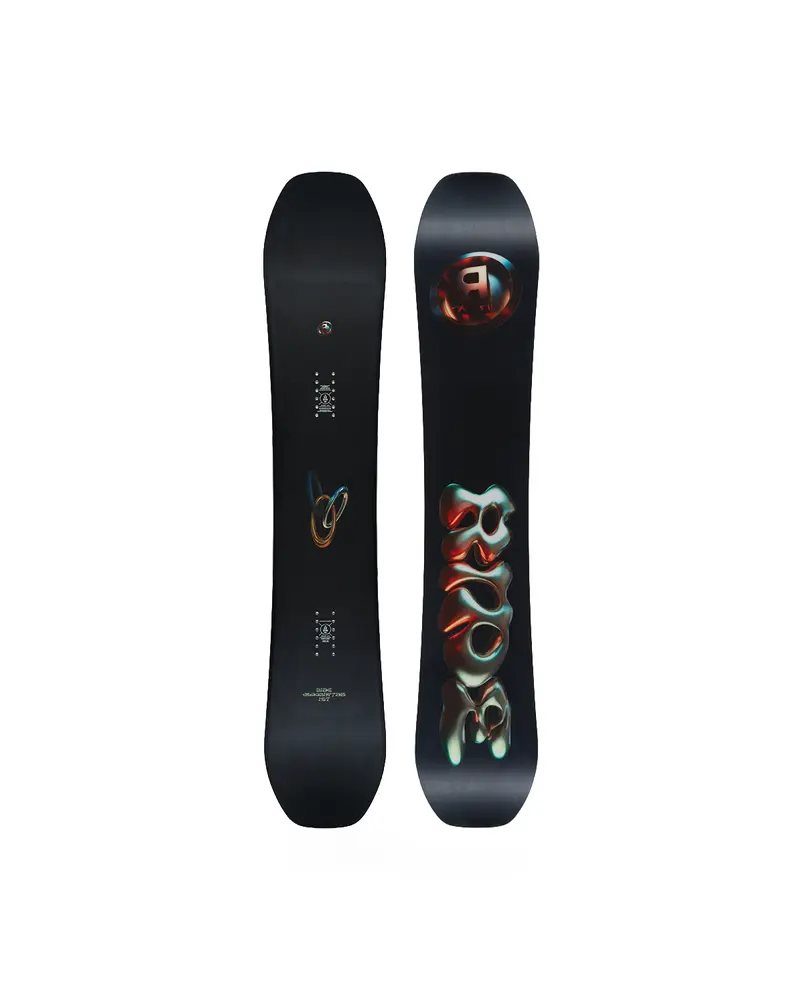

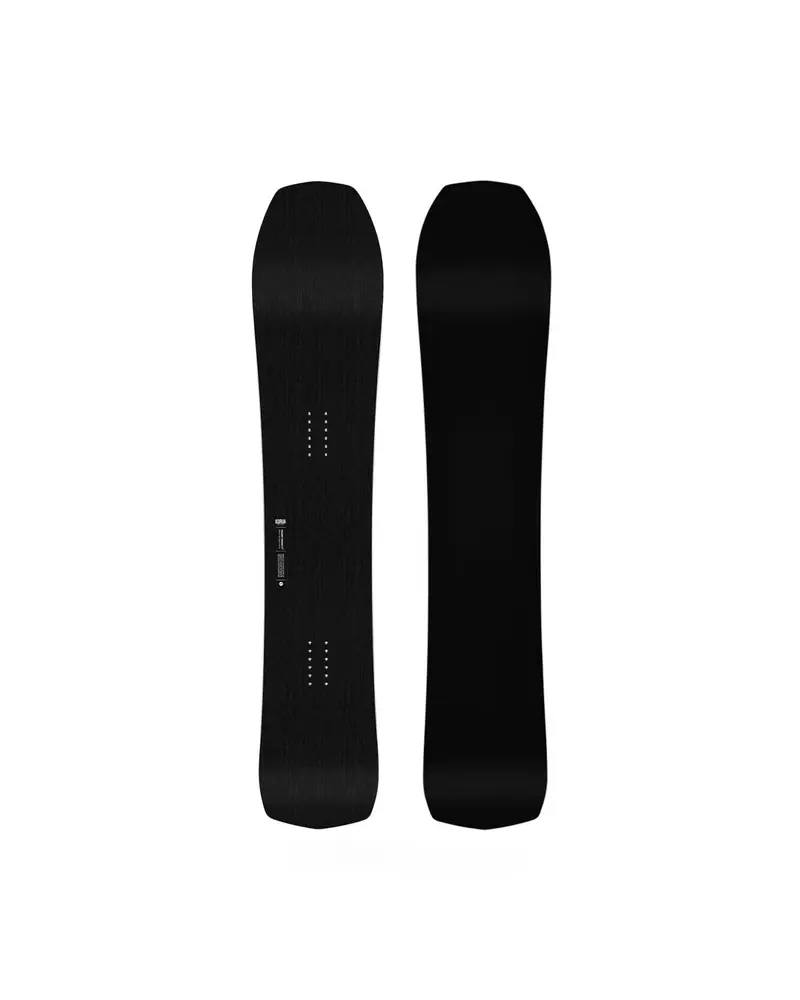
The Ride Algorhythm 2027 is a considered option when you want one board for a varied day. Carved groomers, park jumps, side hits and a detour into fresh snow all fit its programme. Its directional twin shape keeps freestyle useful across the mountain, while Ride’s medium response makes the focus balanced rather than exclusively demanding or loose.
The Standard Camber profile uses a slight traditional camber zone for a responsive feel that does not aim to overpower the rider. It gives you a platform to push against through a turn and at take-off. Ride recommends the Algorhythm for intermediate and advanced riders. It is particularly relevant if you already control your edges and want to develop more deliberate turns and jumps on the same board.

Standard Camber — schematic profile, not to scale.
Equal nose and tail widths mean the Algorhythm has zero taper. However, the reference inserts have 19 mm of setback, so it is not a completely centred twin setup. That combination keeps switch riding part of the picture while adding a forward bias for the rest of the mountain. Choose it if riding both directions matters, but your day is not limited to a dedicated park lap.
The Quadratic Sidecut blends three radii rather than using one continuous radius. On the 157, these measure 9.3 / 6.8 / 9.3 metres for entry, focus and exit. Ride uses the blend to support turn initiation, grip and release. The point is a coherent turn from beginning to end, with geometry designed around this model rather than a generic carving claim.
The Performance Core combines aspen, bamboo and paulownia. Carbon Array 5 channels rider input from the binding area towards the contact points and adds pop without relying on extra overall stiffness. Pre-Cured Glass supports a consistent flex pattern, while Double Impact Plates reinforce the binding zones. Urethane Slimewalls provide damping at the sidewalls, and the stone-ground Sintered 4000 base is worth keeping regularly waxed.
Do not choose between standard and wide by length alone. The 157 has a 254 mm waist, while the 160W is 264 mm. These are different lengths and widths, with different recommended weight ranges. A longer wide board can give the wrong overall fit if you only wanted more boot clearance. Compare rider weight, outsole length and binding angles using the table below. Our snowboard sizing guide explains the main trade-offs; we can help you compare those dimensions with your existing board.
Features & specs
- Shape: directional twin; profile: Standard Camber.
- Response: medium; rider: intermediate to advanced.
- Geometry: zero taper, 19 mm setback, Quadratic Sidecut.
- Construction: Performance Core, Carbon Array 5 and Double Impact Plates.
- Base: Sintered 4000 with stone-ground finish.
| Size (cm) | Nose (mm) | Waist (mm) | Tail (mm) | Taper (mm) | Effective edge (mm) | Sidecut radius (m) | Ref. stance mm (in) | Setback mm (in) | Rider weight (kg) | Rider weight (lb) |
|---|---|---|---|---|---|---|---|---|---|---|
| 151 | 291 | 248 | 291 | 0 | 1121 | 9.1 / 6.6 / 9.1 | 533 (21″) | 19 (0.75″) | 45–82 | 100–180 |
| 154 | 296 | 251 | 296 | 0 | 1147 | 9.2 / 6.7 / 9.2 | 559 (22″) | 19 (0.75″) | 52–88 | 115–195 |
| 155W | 304 | 258 | 304 | 0 | 1159 | 9.2 / 6.7 / 9.2 | 559 (22″) | 19 (0.75″) | 57–93 | 125–205 |
| 157 | 300 | 254 | 300 | 0 | 1172 | 9.3 / 6.8 / 9.3 | 559 (22″) | 19 (0.75″) | 57–93 | 125–205 |
| 160W | 311 | 264 | 311 | 0 | 1197 | 9.4 / 6.9 / 9.4 | 559 (22″) | 19 (0.75″) | 73–100+ | 160–220+ |
| 161 | 304 | 257 | 304 | 0 | 1197 | 9.4 / 6.9 / 9.4 | 559 (22″) | 19 (0.75″) | 59–95 | 130–210 |
| 164W | 315 | 266 | 315 | 0 | 1223 | 9.5 / 7.0 / 9.5 | 584 (23″) | 19 (0.75″) | 77–100+ | 170–220+ |
| Manufacturer geometry; availability is shown in the size selector. W = wide. Taper is calculated as nose minus tail width. Setback is rearwards from centre; stance and setback inch values are converted to mm and rounded. Weight ranges are guidelines. Sidecut radii are entry / focus / exit. | ||||||||||
Beoordelingen
Er zijn nog geen beoordelingen.